
Pileform: AI bookkeeping and VAT automation
Period-close used to take a finance team a full day. Pileform, our AI bookkeeping and VAT automation product, turns a quarter of receipts, invoices, and bank statements into reconciled, post-ready entries, and the close became about twenty minutes of review.
- Sector
- Finance / bookkeeping
- Built by
- Encelyte, end to end
- Status
- In production
- Delivered
- An AI document-capture and VAT-automation product
Our approach
We started where we always start, with an audit of where the time actually went. Most of it was not the judgement calls. It was the mechanical work of reading documents and matching them to entries. So we scoped the smallest system that would remove that work without taking the human out of the decisions that matter.
Then we built it for production from the first commit, not as a demo that reads clean test PDFs. Pileform had to handle messy, real-world invoices in multiple languages, apply tax logic that holds across jurisdictions, and leave a trail an auditor would accept. Because we run it ourselves, every rough edge surfaced on our own books before it reached anyone else's.
What we built
Pile in, form out
A quarter of receipts, invoices, and bank statements becomes reconciled, post-ready entries for Xero, QuickBooks, and BTMS.
Reads real-world documents
It captures line items, dates, amounts, and counterparties from messy invoices across multiple languages, not just clean test files.
Cross-border VAT
It applies the right VAT across jurisdictions, so books that span more than one country close together in a single workflow.
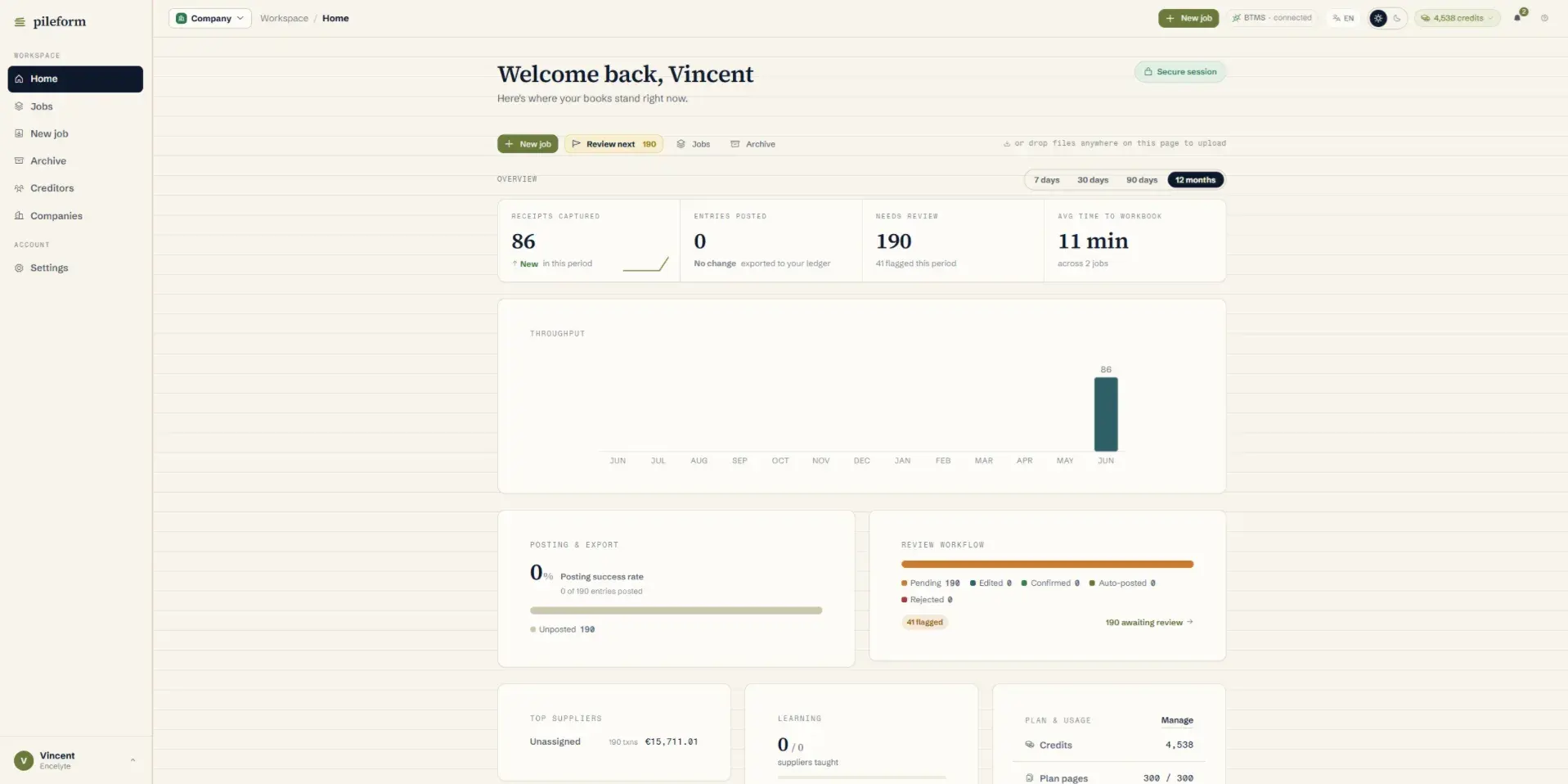
Your books at a glance
One dashboard shows what is captured, what still needs review, and how long the pile took to clear.
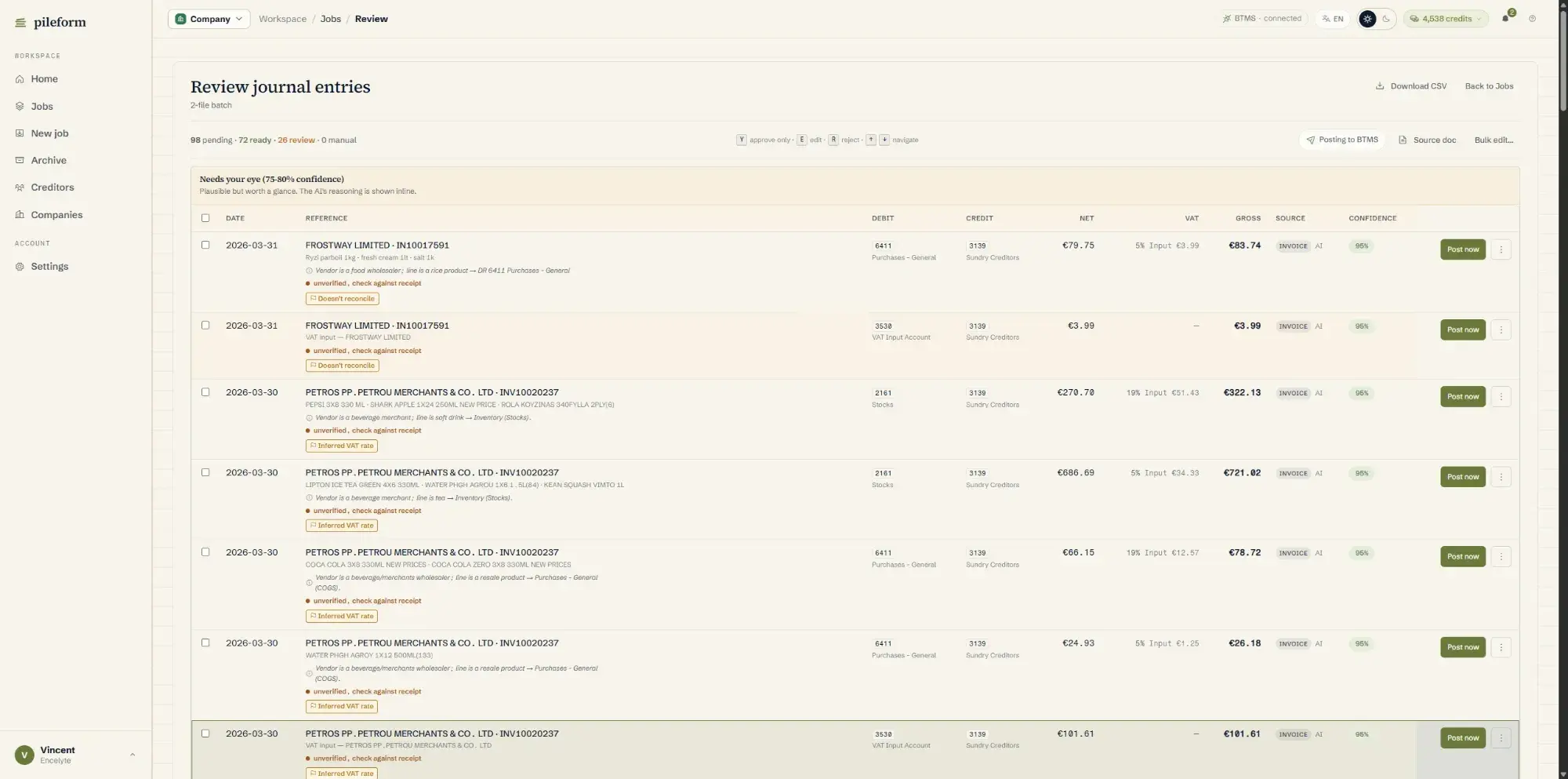
Reviewed, not just read
Every entry arrives with the model's reasoning and a confidence score, so the team checks only the few that need a human eye.
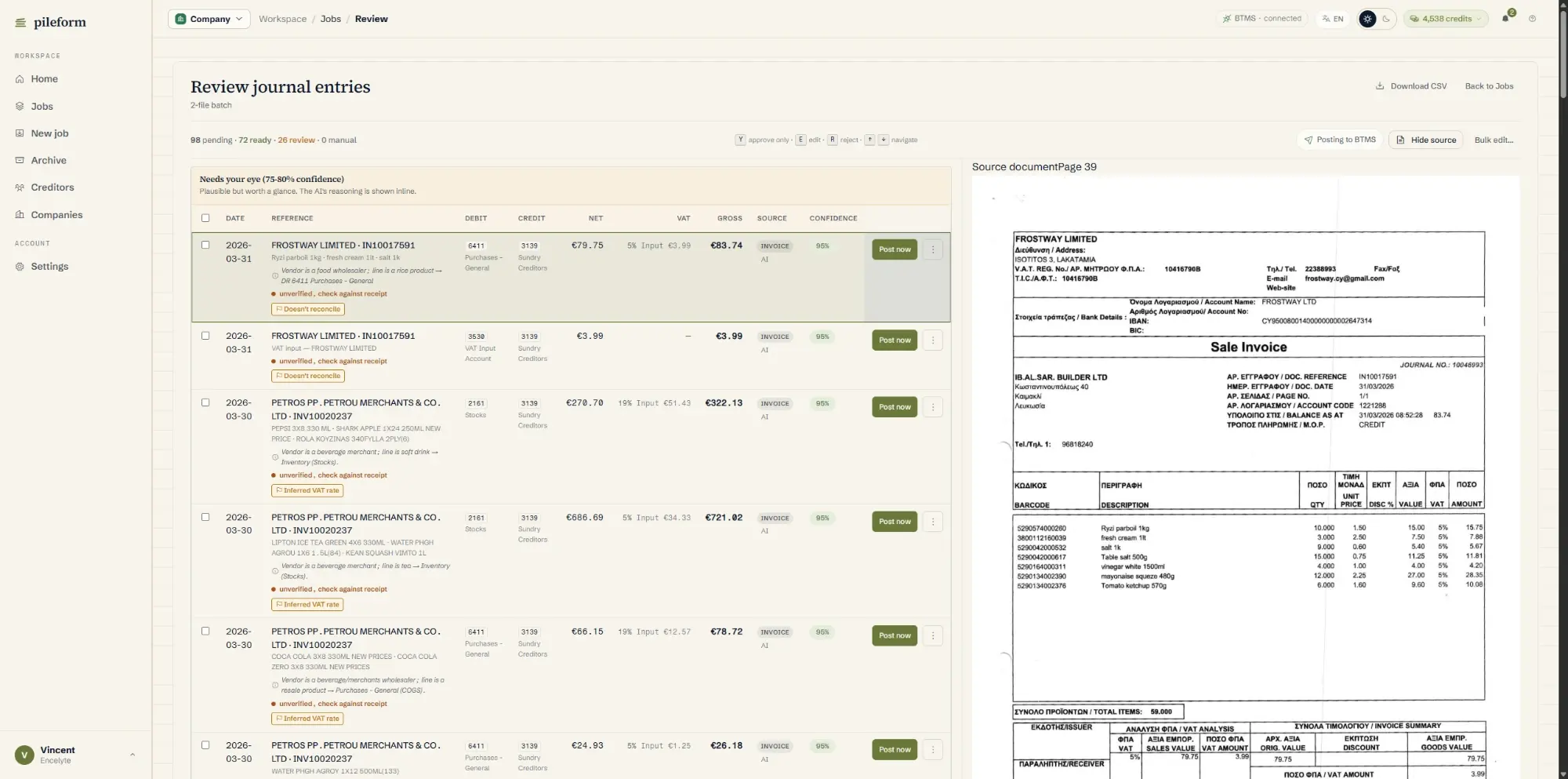
Traced to the source
Each line ties back to the original invoice, one click away. Nothing is taken on trust, and the output stands up to an audit.
Before and after
Before
Period-close is a tax on every finance team. A full day disappears into sorting documents, keying line items by hand, reconciling against the bank, and applying the right VAT rule for each jurisdiction. It holds until the volume grows or the books touch more than one country. Then it stops scaling.
We had the same problem ourselves. So we built the tool we wanted, and held it to the standard we would hold any client build to.
After
The work that used to fill a day is now a short review of the few entries the system flags. The team spends its time on the judgement calls, not the data entry.
Every figure on the return traces back to the document it came from, so the close is faster and the audit trail is stronger at the same time.
Period-close became about twenty minutes of review, down from a full working day.
The stack
- Capture
- Document AI pipeline (OCR + model layer)
- Integrations
- Xero, QuickBooks, BTMS
- Domain
- Cross-border VAT automation
Have a problem like this?
Pileform exists because we got tired of doing period-close by hand. Most teams have a Pileform-shaped problem somewhere: a repetitive, high-stakes process that should be software. If that sounds familiar, tell us about it.