Document AI and RAG, grounded in your own documents
We turn a company's own documents, contracts, manuals, and records into something an AI can read, extract from, and answer over accurately, with a citation back to the source. A private, grounded knowledge system, not a public chatbot.
We build document AI and retrieval-augmented generation (RAG) systems for businesses in Cyprus and across EMEA. The job is the same whether it is invoices, contracts, manuals, or case files: turn your own documents into something an AI can read, extract from, and answer over, with every answer traceable to the page it came from.
This is the one capability we do not just advise on. We ship one ourselves, in daily use, reading and reconciling finance documents in 11 languages. The advice and the product are the same thing here.
Reading, extracting, and answering
Document AI covers two jobs that often run together. One reads documents and pulls structured data out of them. The other lets a person ask a question and get a grounded answer from across a whole library of documents. We build both.
- Extract
Extraction
Invoices, contracts, forms, and scans become structured, checkable data, fields you can post, file, or query, instead of pages someone retypes.
- Retrieve
Retrieval and answering (RAG)
Ask a question in plain language and get an answer drawn from your own documents, with a citation back to the exact source.
- Route
Classification and routing
Documents sorted, tagged, and sent to the right queue or system on arrival, not by hand.
- Read
Multilingual handling
Greek and mixed-language documents read as first-class inputs, not an edge case bolted on at the end.
Answers with a source, not a guess
A plain language model will answer confidently whether or not it knows the answer. RAG closes that leak: the system retrieves the relevant passages from your own documents first, then answers from those, and shows you which passage it used.
“What did we pay Petrolina in Q1?”
€2,198.32 across 47 receipts.
cite · source docRetrieved first, answered from that, shown, not asserted
Grounded, not guessed
Answers come from your documents, with the source shown, so you can verify every one.
Private by design
Your data feeds the answer, not a public model's training set. Your documents stay yours.
Built to be checked
A traceable line from every output back to the page it came from. Nothing taken on trust.
Your documents, kept in Europe
Document AI touches your most sensitive material: contracts, finance records, customer files. We are a Europe-rooted firm, and we build for EU data residency by default.
EU-hosted by default
Documents and processing kept in the EU, not shipped to a region you cannot name.
Audit-trailed
A record of what the system read and what it answered, for the questions a regulator or an auditor will ask.
Governable
Built to fit the EU AI Act's obligations, not retrofitted to them after the fact.
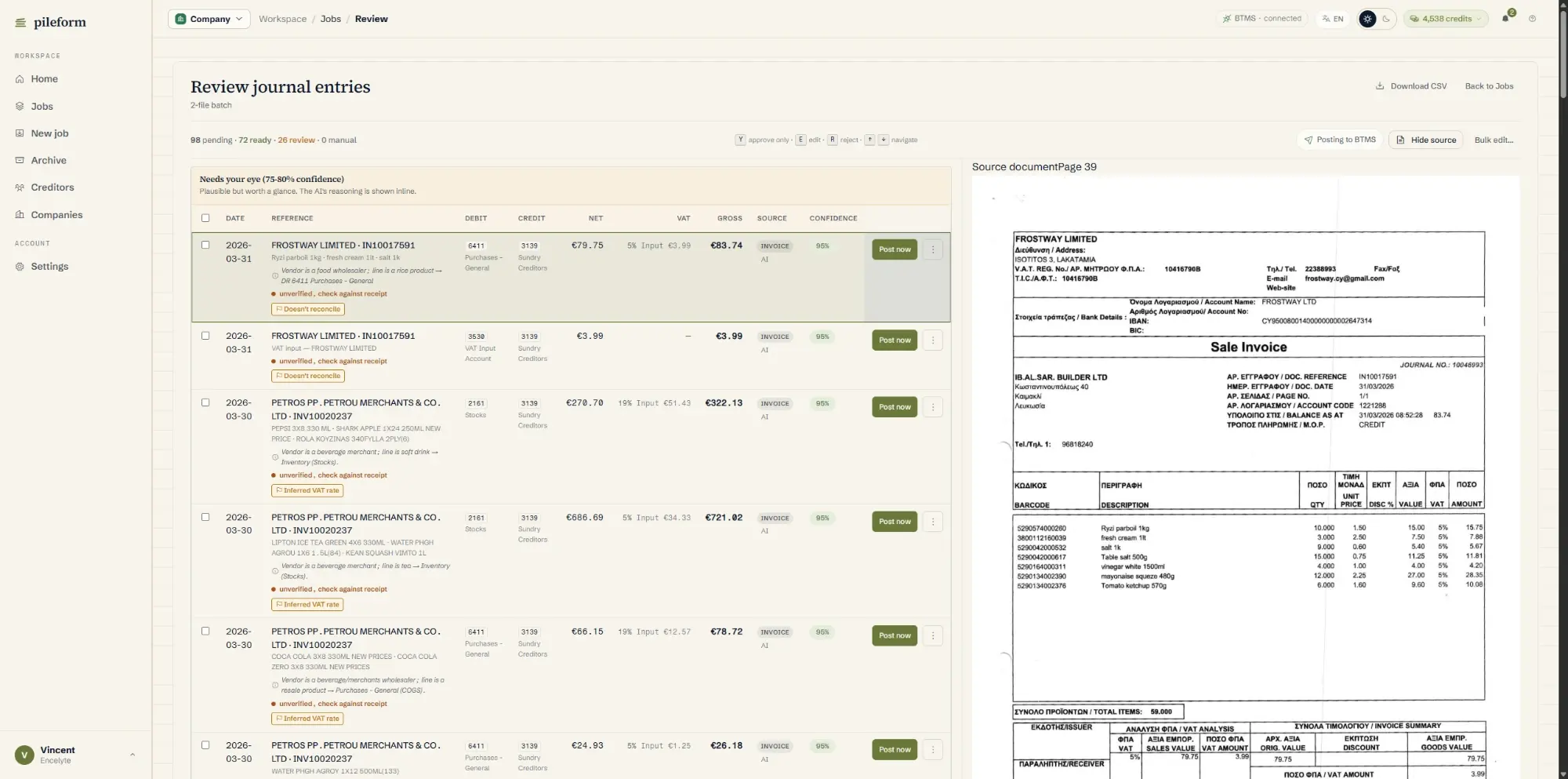
We ship this. It's called Pileform.
Most firms selling document AI have never run one at scale. We have, in daily use by finance teams, reading and reconciling documents in 11 languages across 55 VAT jurisdictions, with Xero and QuickBooks on the other side.
It is the proof behind everything above. A day of period-close becomes about twenty minutes of review. The document AI we build for you holds to the same standard: production-grade, multilingual, auditable, and yours to run.
Questions, answered plainly
What is RAG (retrieval-augmented generation)?
RAG is a way of answering questions from your own documents instead of from a language model's memory. The system retrieves the relevant passages first, then answers from them and shows the source. That grounding is what makes the answer checkable and keeps it from being a confident guess.
How is this different from just using ChatGPT on our files?
A public chatbot has no reliable grip on your documents and no citation back to a source, and it may use your data in ways you cannot control. We build a private system grounded in your documents, with sources shown and your data kept in the EU.
Can it handle Greek and mixed-language documents?
Yes. Multilingual handling is a genuine strength, not an afterthought. It reads documents in 11 languages, and Greek and mixed-language inputs are treated as first-class, not an edge case.
Where is our data stored, and is it used to train AI?
We build for EU data residency by default: your documents are hosted and processed in the EU, under your control. Your data feeds your answers, not a public model's training set.
What kinds of documents can you work with?
Invoices, contracts, forms, manuals, scans, case files, most document-heavy work. Extraction turns them into structured data; RAG lets people ask questions across the whole library and get a grounded answer.
Is this a service you build for us, or just your product?
Both. It is our own shipped product and the proof we run this in production. We also build document AI and RAG systems for clients on their own documents and data, held to the same standard.
How accurate is it, and can we trust the answers?
Every RAG answer carries a citation back to the source, so it is verifiable rather than taken on trust. For extraction, we validate against your real documents and report honest accuracy before anything goes live.
Tell us what's buried in your documents. Extraction, a grounded answer system, or both. We will tell you what is worth building, and we have already built the proof. .